Showing posts with label creative. Show all posts

Sunday, 17 February 2013

The value of creative partnerships


Six London schools talked to A New Direction about their experiences of being involved in the Creative Partnerships programme (2002-2011) how it made a difference to their school and why this approach is helpful in driving positive change.

Talking about their progression since, they discuss the value of a creative approach across the curriculum for its benefits to staff, studentsand the wider community, and how they have managed to continue to maintain partnerships with creative professionals and organisations. Highlighting specific projects and approaches, and the change and impact that these had, others chools can use these six pieces as inspiration, and starting points for their own explorations of creative approaches to teaching and learning, and of building effective partnerships with the creative and cultural sector.

The Thomas Tallis School document can be downloaded here.

Saturday, 10 November 2012

Assessing Creativity


I had a lovely chat with three colleagues from Burnside School in the North East on Friday afternoon. Despite a dodgy Skype connection we managed to discuss our respective school contexts and the issue of how to establish and assess creativity and/or creative learning both within and beyond the arts.

At Burnside they have developed, in partnership with the excellent Susan Coles (@theartcriminal on Twitter) a framework for assessing creativity as a separate subject within the arts curriculum (see images above). The one hour a week course blends aspects of the arts disciplines taught at the school - art, music, dance and drama - but with an explicit focus on developing creative capacity and learning skills. We discussed the pros and cons of teaching creativity within the arts and the responsibility of other curriculum areas for teaching and assessing creative learning attributes.

I shared out brief flirtation with a Creative Learning APP framework and the Creativity Wheel that was created by the Centre for Real World Learning at the University of Winchester. I also talked briefly about our Tallis Lab experiments at KS3 and our commitment to creative learning in the context of ICT.

I really hope we can continue to share ideas and thinking about this area of curriculum development. I also hope that the team at Burnside is able to create a blog to document the progress of their work in this area. I am sure colleagues across the country would be interested in what they have to share.Thanks again to Susan for putting us in touch.

Sunday, 16 September 2012

Pif Paf: creative computer science


PifPafPresentation7min.mov from Al Ma on Vimeo.

 When we decided that the school uniform needed refreshing we could have adopted two different strategies:
  1. decide on an off-the-shelf solution from known suppliers and not worry too much about the design or the ethical or environmental impact of the production process
  2. establish a student led design group to work with a qualified designer experienced in ethical fashion to create a bespoke solution
Obviously, we decided on the second strategy and we were lucky enough to work with the fabulous Alina Moat, a recent graduate from the Centre for Sustainable Fashion at the London College of Fashion. She came highly recommended by the equally fabulous Professor Helen Storey with whom we have been on a number of creative learning adventures. The entire project is documented on this blog.

Alina recently visited our new building to see the students wearing her designs. It was lovely to see how pleased she was with the end result of the project and we are equally proud of the fact that our students are wearing clothes that are genuinely sustainable and distinct. Alina's real reason for visiting however was to tell us about her latest design project and to ask whether we would be interested in collaborating with her. Entitled Pif Paf, the project aims to teach young people how to use programming software by employing a number of creative learning strategies.The video above describes succinctly how a playful combination of physical, emotional and intellectual enquiry results in students mastering complex processes.

We are hopeful that we can support the next phase of the project, testing the model with a class of Year 7 students over several months as part of our Tallis Lab curriculum. We are very excited about the potential of working alongside Alina again on such an innovative solution to the issue of rebooting computer science education in the UK.

Thursday, 24 May 2012

Progression in Creativity report

The Progression in Creativity: Developing New Forms of Assessment report has been published on the CCE website. Year 9 students at Tallis took part in one of the field trials in collaboration with The Centre for Real World Learning (CRL) led by Guy Claxton and Bill Lucas at The University of Winchester. The aim of the research was to establish the viability of creating an assessment framework for tracking the development of young people’s creativity in schools. Initially an assessment tool was established by the researchers (see above).

This tool comprised of 5 habits and 15 sub-habits of creativity:
  1. Inquisitive (wondering and questioning, exploring and investigating, challenging assumptions)
  2. Persistent (sticking with difficulty, daring to be different, tolerating uncertainty)
  3. Imaginative (playing with possibilities, making connections, using intuition)
  4. Collaborative (sharing the product, giving and sharing feedback, cooperating appropriately)
  5. Disciplined (developing techniques, reflecting critically, crafting and improving)
Following two field trials the principal findings were that:
  1. The concept of an assessment framework for creativity in schools is valid and relevant. There was a strong sense among teachers that our framework encompassed a learnable set of dispositions. There are strong grounds for now seeking to develop a more sophisticated prototype, of use to teachers and learners, to track the development of creativity in schools.
  2. The framework should initially focus on the 5-14 age range, although some practitioners may find it useful with younger and older pupils.
  3. The evidence suggests that the primary use of any assessment framework will be formative, supporting pupils to harness more of their creativity and helping teachers more effectively to cultivate creative dispositions in the young people they teach.
As the report indicates "measuring creativity, for teachers, would appear to be a fundamentally different task from measuring literacy or even assessing performance in the creative arts."

Recommendations for further development include from the team include:
  • Maintaining the emphasis on the learnability of creativity;
  • Development of training materials and ‘best practice’ resources for teachers;
  • Incorporating the tool into schools’ reporting systems;
  • Separation of the sub-habits back into three distinct sub-habits;
  • Scrutinising language and selecting a clearly legible printed font;
  • Developing best practice;
  • Developing a more formative tool to point pupils to areas for development;
  • Capturing ‘breadth’ more systematically in the tool;
  • Developing a more systematic evidence collection process;
  • Developing the tool for the virtual environment; and
  • Trialling the tool with the ‘unconverted’.
Read the Report

Sunday, 5 February 2012

iStopMotion on the iPad

I've just discovered that iStopMotion is available for he iPad with the addition of the free remote camera app for the iPhone and iPod Touch. I think this is going to form the backbone of a scheme of work for the equally new GCSE photography course! I just need to give some thought to keeping the iPhone/iPod/iPad steady during image capture. Looks like a bit of research into mini tripods is in order. 


Wednesday, 23 March 2011

Suggestions for the revised Manifesto for Creative Tallis


Hi folks
Thanks for a great meeting this morning. Here are some of the suggestions for the revised manifesto. Comments appreciated:

Everyone's a teacher. Everyone's a learner.

Learn everywhere. Learn your own way.

Cherish knowledge. Pass it on.

Ignite your learning with the spark of imagination.

Activate your network.

Challenged teacher challenge students.

Learning is limitless.

Failure is a learning experience.

Practice Newology and Wonderation.

Remember to bring your imaginations to school.

Be curious. Ask questions. Take risks. Believe in yourself.

Receive. Use. Share. Retrieve.

Nurture your talents, skills and interests.

Get engaged.

Sculpt your learning.

Love what you do.

Sunday, 13 February 2011

Re-creating America

Check out this film about creative learning in Oklahoma:
For much of its history, the word "America" has stood for the brightest ideas, the most resourceful solutions and the most provocative insights. Is this still true today, and if not, what can we do? The film explores the importance of creativity in education by highlighting four schools in Oklahoma and assessing how the state's teachers are attempting to teach and promote creativity: Educare Preschool in Tulsa, OK: serving a low-income, at-risk community; Flower Mound Elementary School in Lawton, OK: integrating the arts into the entire curriculum with the A+ Schools initiative; Odyssey of the Mind, a creative problem-solving competition at Piedmont Middle School; Santa Fe South Charter High School in Oklahoma City: helping students overcome the challenges of poverty and the high drop-out rate in America's urban high schools. The program asks teachers, parents and national experts: what appear to be the most effective ways to promote creativity, while still teaching the three Rs, and even improving test scores?

Monday, 27 December 2010

Manifesto for a Creative Tallis


Thanks to Ms Keville and Ms Piwko we have begun the process of re-thinking our Manifesto for a Creative Tallis. The original manifesto, which has been shared with the whole staff body and was ratified by the Leadership Team, has helped to put creative learning at the centre of the school's learning and teaching vision. It is sent out to all new prospective members of staff and a question related specifically to creative learning features in all new job interviews. In our discussions at the start of this year, we felt that the manifesto needed to be revisited. It was perhaps a bit long and not very memorable. It needed a refresh and, possibly, some serious reflection on making the ambitious statements a reality.

Here are Ms Piwko and Ms Keville's initial thoughts, presented in suitably diagrammatic form:


Here is the first draft of the new statements:
WE CELEBRATE CREATIVITY IN OUR COMMUNITY OF LEARNERS

We encourage:
  • all learners to become inquisitive, imaginative and innovative
  • all learners to take risks, accept challenges and learn from mistakes
  • everybody to reflect on their learning experiences
We support our students to become:
  • resourceful and active learners
  • effective collaborators and communicators
  • independent learners/thinkers
We believe:
  • in the exchange of skills and knowledge between students and staff
  • that the use of new technologies is a crucial part of learning in the 21st century
We value:
  • our students' talents, skills and interests and provide opportunities to develop them further
  • feedback and ideas from students about their learning experiences
  • effective communication about creative learning with parents, carers and members of the local community
We discussed this proposal at our extraordinary meeting before the Christmas holiday and decided to make the following revisions:

(Section 1: We ENCOURAGE……)
  • ‘all learners to become curious, imaginative and innovative ( the word curious has replaced inquisitive in the statement )
(Section 2: We SUPPORT……..)
  • Resourceful, active and independent learners
  • Effective collaborators and communicators
  • Co-creators of the curriculum (this statement has been added as we discussed the importance of students creating the curriculum/ learning experiences with teachers)
(Section 3: We BELIEVE……)
  • in the exchange of skills and knowledge between students and staff.
  • that skills should be transferable
  • new technologies are a crucial part of learning
We talked about the possibility of employing a graphic designer to help us re-present these statements in a more visually stimulating form, perhaps even creating an interactive web based resource that would allow the viewer to explore some of the implications of each statement with examples of successful creative learning, ideas for further research and short video clips of discussions with students, staff members, parents/carers, experts etc.

Whilst browsing in a book shop this evening I discovered a new book by one of my favourite artists, Keri Smith. It's called 'Mess' and describes itself as a 'Manual of Accidents and Mistakes'. This prompted me to check out her excellent website and Flickr account, where I discovered the following manifesto:

Here is the text in full:

The Rebel's Manifesto:

1. Do the opposite of what you were taught in school.
2. Care not for the opinions of others. They are based on their own thoughts and fears.
3. Study the work of other rebels. Steal things from them. Research with fury.
4. Forget about the competition. They are on a different path than you. Trends are for suckers.
5. "There's nothing we really need to do that isn't dangerous." John Cage. Do the things that scare you on a regular basis.
6. Make a mess.
7. Embrace your darkside. Your so called "dark qualities" (or labels) are a source of great power. Find a way to incorporate them into your work. Feature them. pay particular attention to what makes you angry.
8. Exercise your voice. Put your thoughts out into the world even if it scares the shit out of you (see number 5).
9. Expand your horizons. Leave home. Visit other places/cultures. Wander aimlessly.
10. Never limit your play-time. Even if your brain is telling you otherwise. All of your best stuff comes from it if you allow yourself to remain open to the unknown.
11. Question everything.
13. Follow your heart.

I love this for several reasons. The language is quite informal and includes some direct challenges. It's quite irreverent and funny. It feels exciting and surprising. Number 12 is missing. I wonder if we can learn anything from existing manifestos?

As promised I will begin to do some research about potential sources of funding to employ a designer to help us re-present our Manifesto. In the meantime, I wonder if we ought to give some thought to the next document needed to make the statements in our manifesto more of a reality in school - an implementation strategy.

Wednesday, 29 September 2010

First meeting of the new academic year


The Creative Tallis Action Research Group met for the first time this academic year this morning. We have a great combination of new and existing members with the adults outnumbered by students. We really appreciate the students attending this morning since they would officially start school today an hour later. Some of them, in fact, only came in at all because they belong to the ARG. Very noble!

Our discussion focused on three things:

1. What do we want to achieve this year?
2. Who do want to collaborate with?
3. Who will benefit?

After a detailed and lively discussion we agreed to three foci for the year:

1. Developing a creative learning conference/Teechmeet and supporting the whole school creativity festival in the summer term
2. Establishing a creative learning project with a groups of Year 7 students (and their parents/carers) using handheld technologies. The idea would be to encourage the students to document their positive experiences of learning so that these can be shared with the whole community and inform the development of our pedagogy.
3. Working in collaboration with the maths, English and science faculties to develop inter-disciplinary creative learning strategies, possibly through a Teacher Exchange programme.

Thanks for everyone's contributions today. It promises to be a very exciting year again for us.

Sunday, 18 April 2010

Creative Thinking in the Classroom

Image courtesy of Jef Safi

I've just been reading two very interesting blog posts about creative thinking in schools. Lots of the ideas in them will be familiar to you but I really liked the central notion in both that creative thinking is a process of re-thinking through the introduction of deliberate disorganisation. This sounds, on the face of it, a strange process. Why deliberately disorganise your thinking about something? Aren't most educators, especially those with an eye on the fast approaching examinations, hell bent on organising their students' thinking?

The issue, it seems, is that if we move through the thinking process too quickly, we may miss the opportunity to really deepen our understanding of a given topic. Learning comes from experience. We then attempt to understand this experience. Our urge is to apply what we have learned in order to create a record of our learning. But, if we value creative approaches to learning, would we be better off delaying the application phase in order to re-think about our original experience and understanding? What if we jump too soon into a narrow application that provides is a relatively superficial record of our learning? The chances are, in this case, that the learning may not stick since it has not been deep enough.

When given the opportunity to re-explore understandings, the brain often engages in re-comprehension, the sorting of critical details, and re-elaboration, the recognition of new patterns. These new patterns may be new, unique, creative. As the individual examines these new patterns, methods of expressing them may come to mind. These possible expressions are then examined for potential, and if deemed effective, the individual may proceed to producing a creative product.

So, what's involved in this re-thinking? Well, we need to create space and time for our imaginations to work on the original stimulus. We need to explore alternative ways of representing what we understand. We might re-present it to a new audience. We may use metaphor or analogy to compare what we know with something else. We may wish to ask a whole series of questions in an attempt to destabilise what we think we know, to knock it off balance and look at it from a different perspective. Whatever techniques we use to introduce deliberate disorganisation, the chances are that if we allow ourselves the opportunity to reflect, to re-think, when we get to the point where we are ready to reformulate our understanding, we will be able to create a more creative and more deeply realised record of our learning.

I've read a lot of stuff about creativity and creative learning but the ideas contained in these two blog posts come pretty close to summing up my attitude to the value of creative thinking in schools. In case I've misrepresented the thoughts of the authors (by introducing too much deliberate disorganisation of my own) here are the orginal posts:

Creative Thinking in the Classroom Part 1

Creative Thinking in the Classroom Part 2

What are the implications for promoting creative thinking in schools? Here are a few things I would like to see:
  • a more integrated curriculum at KS3 with a central focus on developing independent learners through explicit thinking skills activities
  • Philosophy for Children built into the core curriculum at KS3 and 4 so that learners acquire an ability to question and reflect effectively
  • a greater focus on extended, open-ended home learning assignments that encourage students to re-present what they have learned to a variety of real audiences using a range of tools, processes and techniques
  • a greater emphasis on teachers developing, maintaining, sharing and debating their preferred pedagogy
What would you like to add to this list?

Wednesday, 14 April 2010

Saturday, 23 January 2010

The Future of Learning


The always interesting Stephen Heppell articulating the connection between technology and the development of creative life-long learners.

Friday, 15 January 2010

Ofsted Report on Creative Approaches to Learning and Teaching


Ofsted have today published their long awaited report on creative learning. I haven't had time to digest the full report yet, but there seems to be an acknowledgement that creative learning is desirable and can yield amazing results for young people in a context of secure knowledge and careful planning:
The report, Learning: creative approaches that raise standards, confirms that pupils’ motivation, progress and attainment in primary and secondary schools were improved by creative approaches to learning such as:
  • stimulating pupils with memorable experiences and practical activity
  • allowing pupils to question, explore and challenge ideas
  • encouraging pupils to think creatively
  • supporting pupils to reflect on and evaluate their learning.

Follow the link above to download the report in pdf format. It would be interesting to know what you think of it and whether you believe that creative approaches to learning can have a direct impact on students' motivation, progress and attainment.

Here's an extract from the Tallis PRESS RELEASE to accompany the publication of the report:

**PRESS RELEASE**


Thomas Tallis School in Greenwich is recognised for Creative Learning Practice in latest Ofsted report


Ofsted recognises the benefits of Creative Partnerships and creative learning practices in its latest report: ‘Learning: creative approaches that raise standards’


Thomas Tallis School in Greenwich, a Creative Partnerships School of Creativity has been recognised for its outstanding approach to creative learning in Ofsted’s latest report, ‘Learning: creative approaches that raise standards’. The school was surveyed as part of the report which shows that creative learning practices in schools are improving standards and pupils’ personal development.


Ofsted visited 44 schools for the report and found that almost all were using creative approaches which had a “perceptible and positive impact on pupils’ personal development and on their preparation for life beyond school”. Eighteen of the schools visited are Creative Partnerships schools. Ofsted remarks that Creative Partnerships schools have seen “notable improvements in their levels of achievement and in measurable aspects of personal development, such as attendance”; whilst school leaders were confident about the value of the programme and its impact on teaching and learning.


Rob Thomas, Headteacher at Thomas Tallis School, commented: “We are delighted to be recognised in Ofsted’s new report and are pleased that this report identifies what we see happening in our school every day: that creative approaches to learning raise attainment levels, improve attendance and increase pupil motivation. As a Creative Partnerships School of Creativity, we will continue to further develop our teaching and learning practices to help to shape future education policy and practice."

Sunday, 22 November 2009

Mr Barrett I have got glue on my laptop!


This Voicethread comes from Tom Barrett's excellent ed.tech blog. I like the idea here of blended learning tools - the laptop, the glue, the colouring pencils etc. - and the ambition to have such tools available for all learners when they are relevant. I suppose this is what we're aiming to do with Tallis LAB and, hopefully, in all classes in the new school.

The other important thing to remember here is that we need to get to know the learners very well in order to be able to provide the tools that will suit them best when they need them or, to put it another way, we need to have the tools available so that they can choose the best tools with which to learn. Another implication of this approach to learning is that assignments may need to be a bit more open ended, open to interpretation and, well, just more open. Learning can be presented in so many different ways so maybe we could allow learners to choose how to tell us and each other what they have learned? When I think of Creative Learning, this is what I imagine.

I had a conversation with a colleague the other day about what he perceived to be competing agendas. He implied that the drive to raise standards, particularly at KS4, was somehow in competition with what he called the "liberalisation" of the curriculum and messages about increased opportunities for creative learning. I understood what he was saying but I think this is another good example of the way creativity and creative learning are almost willfully misinterpreted to mean soft, woolly and lacking in rigour. My view, and I believe the view taken by experts in the field, is that this is plain wrong. Creative learning requires discipline, imagination, resilience, time-management, self-control, energy and commitment. Surely these attributes are just what is needed to raise standards of learning? It seems that there is still a linguistic battle to be fought and definitions to be agreed upon but those in the standards camp are surely not suggesting that learners need to be less creative. Are they?

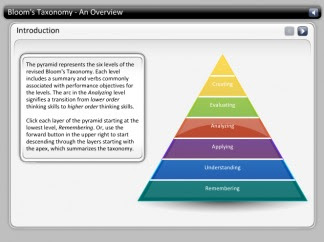
Perhaps we should re-visit Bloom's Taxonomy. I hear a lot about "higher order thinking" in school, especially from certain colleagues who are creativity skeptics. I'm sure they are of the opinion that creative learning is all well and good when you have the time and maybe for a couple of weeks in the year when the exams are over. I'm not sure which version of Bloom's Taxonomy they are familiar with but I've recently added a section on the latest one to the Creative Tallis site. This is what I've written:
Benjamin Bloom first published his "Taxonomy of Educational Objectives" in 1956. It attempts to classify different forms and levels of learning. Bloom identifies three domains in which this learning takes place - the cognitive, the affective and the psychomotor. The most discussed of these is the cognitive domain. The original levels within this domain were: knowledge, comprehension, application, analysis, synthesis and evaluation. Educators often refer to the notion of "higher order thinking". The belief is that, once the lower order thinking skills (knowing, understanding, applying) have been acquired, higher order thinking can take place (analysis, synthesis and evaluation).


In 2001, Anderson and Krathwohl proposed a revised model of Bloom's taxonomy for the cognitive domain. The illustration above provides a link to an animated resource describing this model. There are two significant changes:

1. the shift from nouns to verbs
2. the top category has changed from "evaluation" to "creating"
According to this model, the ability to create new knowledge, to create something original and of value, belongs with the higher orders of thinking.

Perhaps we should re-visit the notion of creativity as the highest order of thinking? What we also need are more concrete examples of creative thinking for the website. If you have any such examples from your experience at Tallis please let me know and I will be sure to include them on the creative learning page of the site.

Wednesday, 23 September 2009

Plans for this year


Hi folks and a belated welcome back to the new year at Tallis.

Just thought I'd pose a couple of questions to get you thinking about our plans for this year. If you could return your thoughts via a comment I would be most grateful:
  1. What do you think should be the focus of our investigations this year?
  2. Should we expand the membership of the group? We've lost a couple of very valuable Year 13 members (although I'm hoping Tom will continue to play a part in our discussions. Who else should we invite to be in the Creative Tallis Action Research Group?
  3. What do you think about the idea of continuing our collaboration with Tangled Feet in some form? Could we create some kind of community, site-specific performance together? How else could we work with visiting artists/practitioners to explore creative learning?
  4. Are any of you interested in doing the Arts Award based on your involvement in Creative Tallis? We looked at this last year but didn't get very far. Should we have another go?
  5. Do you think it's a good idea to set up a kind of Creative Learning Council for students. My thoughts here are that we could empower students to create briefs and commission work from visiting (or in-house) creative practitioners using the School of Creativity budget. The students would be responsible for identifying the scope and aims of the partnership, negotiating with staff members about the curriculum focus, writing the briefs, documenting the projects and evaluating the outcomes. Obviously, they would trained in these skills and have support from other members of staff. What do you think?
That's enough questions for now. I'm seeing John this week to go through some of these issues and complete the paperwork from last year. It would be good ot have your thoughts ASAP.

Friday, 19 June 2009

Creative Agents Conference Invitation


We've been invited to do a small presentation to all the London Creative Agents at a special conference on 1st July. The venue is the October Gallery (the gallery specialises in promoting the Transvanguard and is currently hosting an exhibition of the work of Gérard Quenum, hence the image above).

Anyway, Judith Ackrill sent me this email today confirming some of the arrangements and suggesting a couple of themes for us to get our teeth into:

Dear Jon

Great to speak to you just now, and thank you again for getting involved with this creative agents day.

We agreed that the theme of the students presentation would be along the lines of 'how do we communicate with each other and with the school about creativity and what effect is this having?' In other words, a sort of case study for the AND creative agents to hear about.

The session could include a projected presentation from a laptop (we can provide the laptop); we are also checking whether the broadband signal is good enough to use live on-line examples, and I'll get back to you about this. You might also bring handouts.

The creative agents enjoy active sessions, and we agreed there should be time for questions and discussion.
One of the topics you would like to cover, either in the presentation or as a question back to the agents, is 'how can we promote this way of working to other schools and groups?'

If the students would like to include an activity for the agents as part of the session that would be fine too. Let me know if you need flipcharts.

We agreed you would talk to John on Monday about how/whether he would like to be involved, perhaps introducing the school or taking part in the session. Also you'll speak to John about the idea of the students leading an active warmup for the agents for 10 minutes at 10am; if they would rather not do this pls let me know and I'll find someone else.

Nuts and bolts: The session (including the 10-minute warm-up) runs from 10am to about 11. The room is upstairs and there will be about 30 people in the 'audience'. We can provide squash and coffee and biscuits after the session, and I understand there may be 6+ people in the group including yourself. Ideally you should arrive a little early, in time to check out the technology and get your bearings - say 9.45?

I'll forward information about the October Gallery next week, with the names of the creative agents and AND team and final news on the broadband question.

It would be good to know how many of you are interested in taking part in this presentation. It would be a great bit of evidence for your Arts Award portfolios and I'm sure you'd all do a great job. I'm seeing John on Monday, so if you could let me know over the weekend either by email or via a comment on this post, I'd much appreciate it.

Monday, 25 May 2009

Creative Learning Forum

One of the features of the new website is a Creative Learning Forum. The idea is to stimulate discussion about creative learning from visitors to the site. I've posted a couple of discussion topics but I need some help to get the ball rolling (and to check that the forum form works) so it would be great if you could head over there and leave a comment or two. If you're feeling up to it you might even want to start a discussion of your very own. Remember, the site is intended to be about creative learning generally as well as what's happening at Tallis.

Friday, 15 May 2009

Creative thinking t-shirt

We didn't get a massive response last time to the call for creative learning t-shirt slogans so here's another chance to throw your hat into the ring. This design comes courtesy of those clever folk at Threadless.